
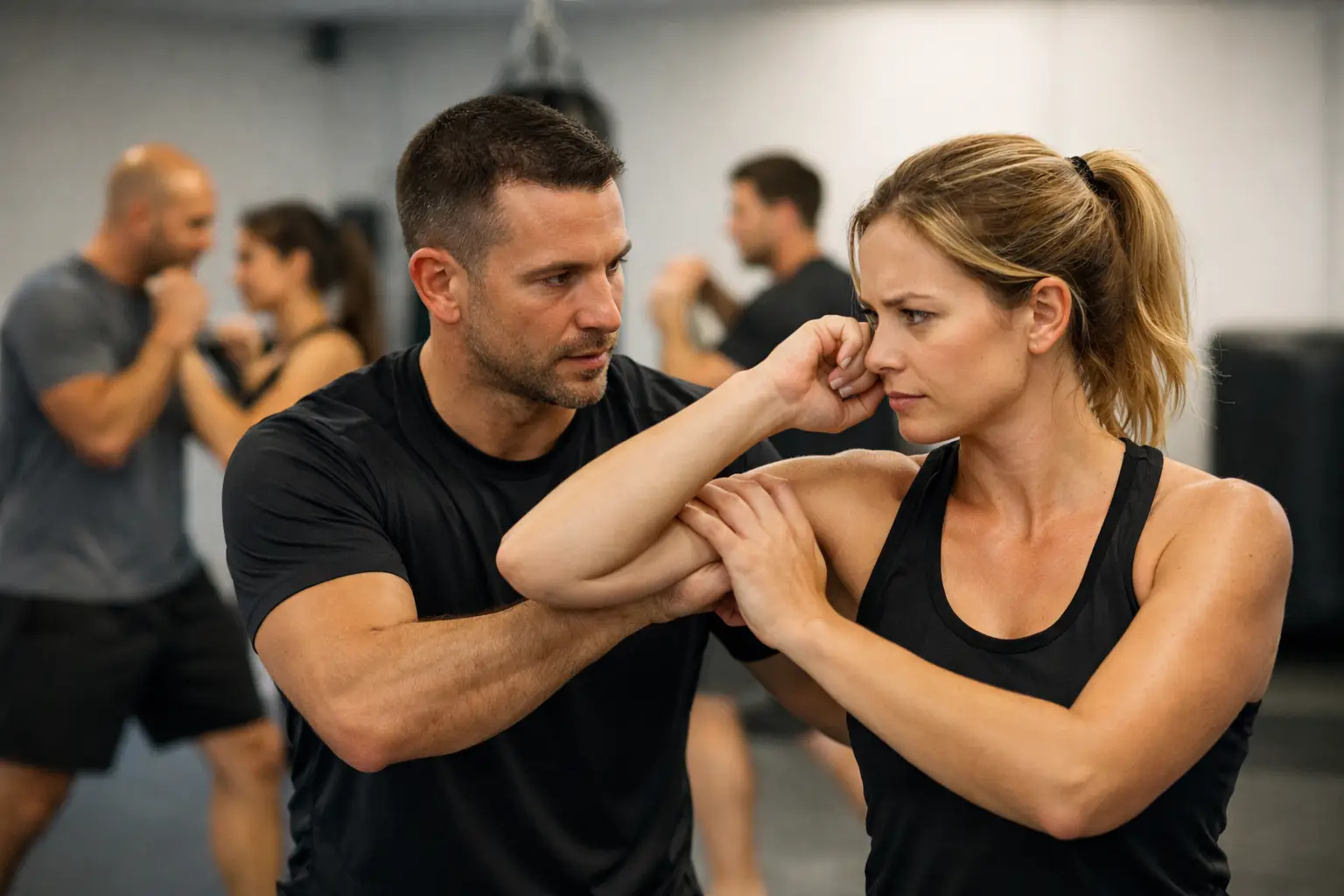
Most workouts leave you tired. The right self defense fitness classes leave you sharper, stronger, and more prepared to handle pressure when it counts. That difference matters if you want more than calories burned and sweat on the floor. It matters if you want training that improves your conditioning while teaching you how to move, react, and protect yourself in the real world.
A lot of people start looking for classes because something feels off. Maybe you walk to your car late and realize you have no plan if someone closes distance fast. Maybe you want your teen to build confidence without getting pulled into a sport-only mindset. Maybe you are simply bored with gyms that promise results but never give you a reason to stay consistent. Practical training solves a different problem. It gives your fitness a purpose.
What makes self defense fitness classes different
Not every martial arts or cardio class belongs in the same category. Some programs are built around point scoring, forms, or general exercise. Those can still be useful, but self defense fitness classes should train the body and mind for realistic situations, not just controlled drills that look good in a studio.
That means the physical side of training needs to connect directly to function. Footwork should help you create space. Striking should improve balance, timing, and power under pressure. Partner drills should build awareness, not just repetition. Conditioning should support stamina when adrenaline hits, not only performance in a predictable round.
This is where many people get disappointed. They join a class expecting real-world value and get a fitness routine with a self-defense label on it. There is a big difference between hitting pads for a workout and learning how to manage distance, protect your balance, respond to grabs, and stay composed against resistance.
Fitness that serves a real purpose
The fitness benefits are real, and they come fast when training is structured properly. You build cardio, coordination, strength, mobility, and endurance all at once. But the bigger advantage is that these gains are tied to useful movement. Instead of training your body in isolation, you train it to solve problems.
That matters for adults with busy schedules. If you only have a few hours a week to train, you want a return that goes beyond aesthetics. Self-defense-based conditioning improves your engine, but it also sharpens reactions, posture, awareness, and body control. Those benefits carry into daily life – at work, at home, and in unpredictable environments.
For beginners, this kind of training is often more engaging than a standard gym routine. There is a clear reason behind every drill. You are not just doing another set. You are learning how to move with intent, manage stress, and become harder to overwhelm.
What to look for in self defense fitness classes
If your goal is real-world readiness, the class structure matters more than the marketing. A good program should be beginner-friendly, but it should not water down the purpose of the training. You want instruction that is safe, progressive, and practical.
Look at how the school teaches. Are students learning timing, awareness, and decision-making, or just memorizing sequences? Are they exposed to realistic scenarios in a controlled way? Is the training built for different body types and experience levels? A serious program meets people where they are, then helps them develop usable skills step by step.
You should also pay attention to whether the curriculum includes both empty-hand and weapons awareness. Real-life threats are not always clean or predictable. A school that teaches only one narrow lane may help your fitness, but it may leave major gaps in your understanding of self-protection.
At Urban Edge Martial Arts, that practical standard shapes the training. Students work through a combat-focused curriculum that blends Pekiti Tirsia Kali and Okinawan Kempo to develop both armed and empty-hand skills, with an emphasis on realistic pressure rather than sport-only performance.
Why realistic training builds better confidence
Confidence gets misunderstood all the time. Real confidence is not loud. It does not come from pretending you can handle anything after a few classes. It comes from exposure, repetition, and proof.
When people train in a serious but supportive setting, they learn what pressure feels like. They learn where they tense up, where they hesitate, and where they need work. That can be humbling at first, but it is also how durable confidence is built. You stop relying on guesswork because you have practiced under guidance.
This is especially important for adults who have never done martial arts before. Many assume they need to be in shape before they start. The truth is the right class helps you get in shape while you learn. You do not need to show up ready. You need to show up willing.
For teens, the benefit is just as strong. Structured training gives them challenge, discipline, and a productive way to handle stress. For parents, that matters as much as physical fitness. You want your child developing composure, respect, and awareness, not just throwing techniques around.
The trade-off between hard training and smart training
There is a difference between intensity and effectiveness. Some schools mistake exhaustion for progress. If every session leaves students crushed but confused, that is not smart training. On the other hand, classes that are too soft may feel comfortable but fail to prepare people for real resistance.
The best self defense fitness classes balance both. They push your conditioning while keeping the instruction clear. They increase intensity as your skill improves. They challenge you without turning training into chaos.
That balance matters for long-term progress. If a program is too aggressive too soon, beginners quit or get hurt. If it never gets demanding, students plateau. Good coaching keeps people moving forward safely while still respecting the reality of self-defense. Pressure has to be introduced thoughtfully, not theatrically.
Who benefits most from this kind of training
Working professionals often get the biggest return because they need efficient training. They want stress relief, better conditioning, and practical skills in one place. Parents benefit because they are not only improving their own readiness but also setting an example of discipline and resilience. Families benefit because training becomes a shared activity with long-term value instead of just another short-lived program.
This approach also fits people who never connected with traditional gym culture. If counting reps on a machine feels disconnected, a skills-based environment can keep you consistent. You are learning, adapting, and improving every week. That keeps motivation high because progress is measurable in more than one way.
It also works well for beginners who feel intimidated by competitive combat sports. A practical program can still be demanding without making competition the center of the experience. The goal is not to win points. The goal is to become more capable.
How progress usually feels in the first few months
Most new students notice better stamina first. Warm-ups get easier. Movement starts to feel more natural. Then coordination improves. Your hands and feet begin to work together with less hesitation. After that, confidence starts to show up in subtle ways. You carry yourself differently. You pay more attention. You feel less frozen by uncertainty.
Skill development is not linear, though. Some days your timing clicks. Some days it does not. That is normal. The important part is training in a system that builds competence over time instead of chasing quick-fix promises.
You should expect effort. You should expect to be challenged. But you should also expect coaching that gives those challenges a clear purpose. The right environment makes it possible to train hard without feeling lost.
Choosing a class you will actually stick with
A great program on paper means nothing if you do not keep showing up. That is why coaching style, class culture, and structure matter so much. People stay consistent when the training is demanding, the instruction is clear, and the environment feels supportive without being soft.
Look for a school that takes beginners seriously. That means organized classes, clear progression, and instructors who can explain not just what to do, but why it works. A strong community helps too. Training partners should push you, not posture around you.
If you have been thinking about starting, the best time is before you feel ready. Readiness is built through action. The right class will meet you where you are, challenge you honestly, and help you build the kind of fitness that means something when life gets unpredictable.
Train for more than the workout. Train so your strength, stamina, and confidence have a job to do.