
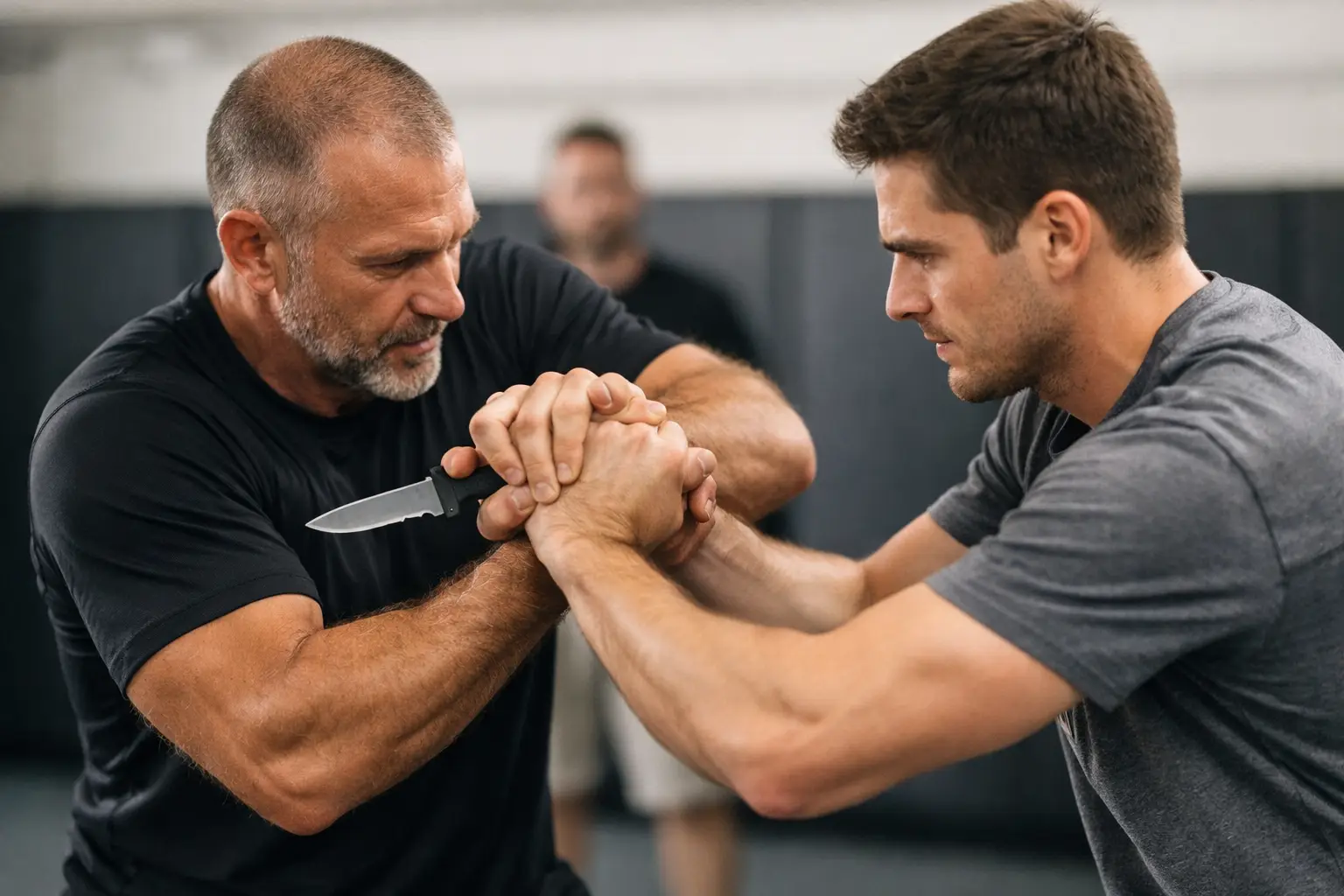
A knife changes the stakes fast. It cuts through bad assumptions, flashy techniques, and false confidence in seconds. That is why knife defense training for beginners should never start with movie disarms or complicated choreography. It should start with reality.
For most beginners, the first lesson is simple: if escape is possible, that is the best option. A knife encounter is dangerous, chaotic, and often over before people understand what happened. Good training does not sell fantasy. It teaches awareness, positioning, timing, and the ability to make better decisions under pressure.
What beginners need to understand first
Many people come into training with one question: “Can I really defend against a knife?” The honest answer is that there are no guarantees. Even trained people can get cut. That is not fear-based messaging. That is the level of respect a blade demands.
The goal of training is not to make you feel invincible. The goal is to improve your odds. That means learning how violence actually unfolds, how distance affects survival, and how stress changes your reactions. A strong beginner program builds that foundation before it adds speed or complexity.
In practical terms, that includes understanding pre-contact cues, managing space, protecting vital targets, and using footwork to avoid standing in front of the attack. It also means recognizing that the best “defense” may be escape, using barriers, or complying long enough to create a chance to get out. Real self-protection is decision-making, not just technique.
What knife defense training for beginners should include
A serious beginner program keeps things direct. You do not need twenty fancy responses. You need a few high-value skills trained consistently.
Awareness and avoidance
The strongest self-defense skill is spotting trouble early. That means reading body language, recognizing suspicious movement, and paying attention to hands, distance, and environment. Instructors should teach students how attacks are often set up, not just how they finish.
This matters because many knife assaults do not begin with a dramatic reveal. The weapon may be concealed. The attacker may close distance while talking. The situation may look like an argument right before it turns into a burst of violence. Beginners need training that sharpens awareness before a blade is ever visible.
Footwork and distance management
Beginners often focus on the hand with the knife. That is natural, but it is incomplete. Your feet decide whether you stay in danger, create an angle, or get out.
Good footwork in knife defense training for beginners teaches movement off the line, not freezing in place. It trains students to avoid backing straight up if there is a better angle, to keep balance under pressure, and to move with purpose rather than panic. Distance is one of the few advantages you can create quickly, so this piece has to be trained early.
Protective structure and body positioning
A beginner does not need acrobatics. A beginner needs a reliable protective posture that helps shield the head, neck, and torso while moving. This includes keeping the body organized, using the arms intelligently, and staying mobile.
No position makes you untouchable. That is the trade-off. But a strong protective structure can reduce damage, buy time, and create the moment you need to escape or counter decisively.
Simple counterattacks and control concepts
Once contact happens, things get messy. Fine motor skills drop. Complex sequences fall apart. That is why good training favors simple, repeatable actions.
Depending on the situation, that may include crashing in at the right moment, disrupting the attacker’s balance, controlling the weapon-bearing limb, and striking to create a path out. The exact method depends on distance, timing, and the attack pattern. What matters for beginners is learning core principles that work across scenarios, not memorizing dozens of one-step solutions.
Pressure testing
This is where many programs separate themselves. Technique that looks clean in the air can collapse when the attacker resists, surges forward, or changes rhythm. Beginners need controlled pressure testing to understand that difference.
That does not mean throwing new students into chaos on day one. It means progressive training. Start with pattern recognition and mechanics. Add movement. Add resistance. Add verbal distraction, timing pressure, and realistic unpredictability. Confidence built this way is steadier because it is earned.
Common mistakes beginners make
The biggest mistake is chasing the perfect disarm. Disarms can happen, but they are not where a beginner should build false confidence. If a school leads with flashy weapon takeaways before teaching awareness, positioning, and control, that is a red flag.
Another mistake is training too cooperatively for too long. If every partner feeds the same attack at the same speed and freezes at the right moment, students learn performance, not protection. Drill quality matters.
Beginners also underestimate the emotional side of violence. Heart rate spikes. Vision narrows. Decision-making gets rough. That is why verbal commands, stress exposure, and scenario work matter. The more realistic the context, the more useful the training becomes.
Finally, some people assume fitness and toughness are enough. They help, but they are not substitutes for skill. A strong, athletic person with poor timing and no understanding of range can still get overwhelmed quickly.
How a good beginner class should feel
A strong class should challenge you without overwhelming you. You should leave with clear takeaways, not confusion. The environment should be disciplined, but beginners should also feel supported enough to ask questions and make mistakes.
At Urban Edge Martial Arts, that balance matters. Realistic training does not require ego, and beginners do not need to prove anything on day one. They need structure, coaching, and repetition that builds real skill over time.
The right program will usually blend technical drilling with scenario-based work. You might practice entries, angles, and protective positioning in one phase, then apply those ideas against more realistic movement later. That progression helps students build confidence without pretending danger is simple.
Why weapons training helps even when you are unarmed
This is one of the most overlooked parts of self-defense. When students learn how knives are actually used in motion, their defensive understanding improves. They start to see lines of attack, realistic timing, and common patterns that would be invisible to the untrained eye.
That is one reason systems with a strong weapons base can be effective for self-protection. They do not treat the knife like a gimmick. They treat it like a real threat that requires respect, timing, and positional awareness. For beginners, that creates a more honest learning curve.
It also builds composure. When students handle training blades, work through controlled drills, and gradually face more pressure, they stop reacting with pure panic. They begin responding with structure. That shift is one of the first real signs of progress.
Is knife defense training right for every beginner?
Usually, yes – if it is taught responsibly. Not every beginner wants hard-contact intensity right away, and that is fine. Good instruction meets people where they are while still preparing them for reality.
Parents may be looking for practical safety skills for a teen. Adults may want confidence after a close call or simply want training that feels more relevant than point sparring or forms. Working professionals may want a serious outlet that improves focus and conditioning at the same time. Knife defense training can serve all of those goals, but the delivery has to be smart.
If a program is all fear, it burns people out. If it is all fantasy, it sets them up to fail. The right approach is clear, disciplined, and realistic, with enough support to keep beginners improving week after week.
What progress looks like in the first few months
Early progress is not dramatic. It is practical. You become more aware of distance. Your flinch response gets cleaner. You move with more purpose. You stop reaching recklessly for the weapon hand and start understanding angles, timing, and control.
You also get more honest about self-defense. That is a good thing. Real training replaces panic and fantasy with measured confidence. You begin to understand what you can do, what you should avoid, and where your limits still are.
That kind of confidence carries over beyond the mat. People stand differently. They pay attention sooner. They handle stress better. They feel more prepared, not because they think they can beat anyone, but because they have trained with intent.
If you are considering knife defense training for beginners, look for a program that respects the danger, teaches simple high-value skills, and pressure-tests what it teaches. The goal is not to impress you for one class. The goal is to make you harder to overwhelm, more disciplined under stress, and better prepared to protect yourself when it counts.