
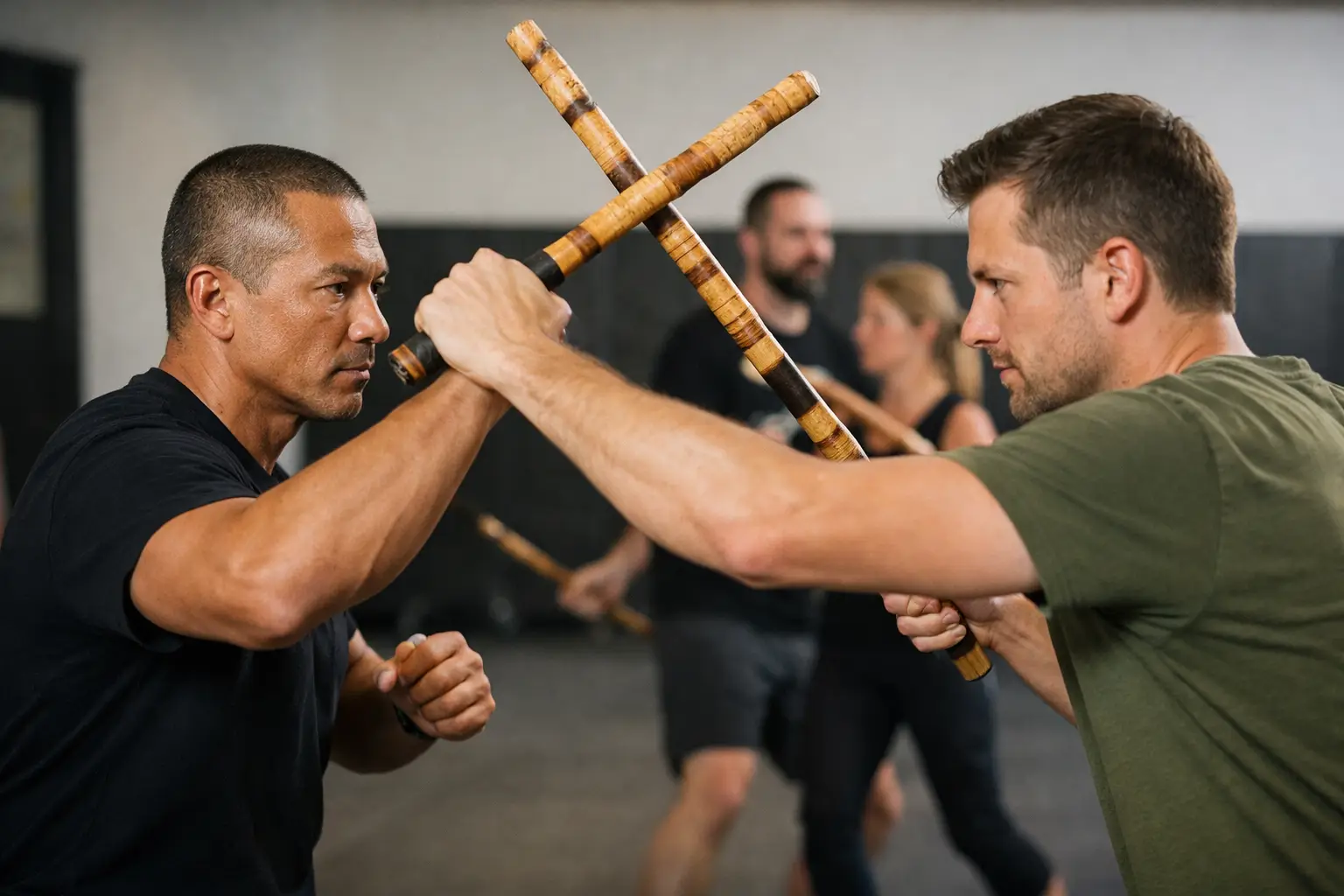
If you are looking at Pekiti Tirsia Kali classes, you are probably not searching for flashy moves or point sparring. You want training that makes sense under pressure. You want to know what to do when distance closes fast, when a weapon is involved, or when adrenaline hits and fine motor skill starts to disappear.
That is exactly why Pekiti Tirsia Kali stands out. It is a weapons-based Filipino martial art built around timing, footwork, edged weapon awareness, impact weapon defense, and practical close-range survival. More importantly, good instruction does not treat weapons work like a niche skill. It teaches you how armed movement, body positioning, and tactical decision-making improve your empty-hand self-defense too.
What makes Pekiti Tirsia Kali classes different?
A lot of martial arts teach self-discipline, coordination, and fitness. Those are real benefits, but they are not the whole picture. Pekiti Tirsia Kali classes are different because they start from a more realistic question: what happens when the threat is fast, aggressive, and possibly armed?
That changes the training.
Instead of focusing only on long-range striking or rule-based sparring, students learn how to manage lines of attack, control distance, and respond to dangerous angles. The system is known for its blade orientation, but that does not mean every class is about fighting with knives. It means the training respects how quickly real violence can happen and how little room there is for error.
For adults, working professionals, and parents, that practical focus matters. You are not spending months on movement that only works in a controlled match. You are training awareness, reaction speed, structure, and composure in ways that carry over to real-world self-protection.
Why weapons-based training improves empty-hand defense
This is where some beginners hesitate. They hear “weapons-based” and assume the training is too advanced, too intense, or not relevant unless they plan to carry a weapon. In reality, the opposite is often true.
Weapons training exposes bad habits quickly. If your footwork is off, your timing is late, or your positioning is weak, the mistake becomes obvious. That creates a sharper learning environment. You start to understand range in a way that many empty-hand systems never fully develop.
When taught well, Pekiti Tirsia Kali classes build skills that matter across the board – hand speed, coordination, defensive structure, off-line movement, tactical entry, and the ability to stay organized when pressure rises. Those are not abstract martial arts concepts. They are practical survival attributes.
There is also a mindset benefit. Students become more aware of how threats actually develop. That awareness often improves judgment, which is one of the most valuable self-defense tools you can have. Avoidance, positioning, and fast recognition are always better than reacting too late.
What to expect in Pekiti Tirsia Kali classes
A serious class should feel structured, focused, and challenging without being chaotic. Beginners do not need previous martial arts experience, but they do need coaching that builds skill in the right order.
Most classes begin with movement preparation. That can include footwork, mobility, and coordination drills that support fast directional change and balance. From there, training usually moves into technical work. Students may practice striking patterns, defensive responses, partner drills, range transitions, and controlled flow exercises designed to sharpen timing.
Depending on the program, you may also work with training knives, sticks, or empty-hand applications that grow directly from the weapons material. This is one of the strengths of the system. It is not fragmented. The mechanics connect.
Pressure matters too. Not every session should feel like a brawl, but if training never adds resistance, speed, or decision-making stress, students can develop false confidence. Strong Pekiti Tirsia Kali classes introduce pressure progressively. You build the mechanics first, then test them under more realistic conditions.
That balance is important. Too much intensity too soon can overwhelm beginners. Too little realism leaves skill unproven. Good instruction finds the middle ground.
Who benefits most from Pekiti Tirsia Kali classes?
The short answer is almost anyone who wants practical self-defense and is willing to train consistently.
Adults often come in because they want something more useful than a cardio workout and more grounded than traditional forms. They want training that improves confidence and fitness while also preparing them for real confrontation. Pekiti Tirsia Kali delivers that, especially for people who care about urban safety, close-range threats, and realistic response options.
Teens benefit for a different reason. The structure of training builds focus, discipline, and emotional control. They learn how to move with purpose, how to stay calm under pressure, and how to take instruction seriously. That has value well beyond martial arts.
Parents are often looking for a program that does more than keep kids active. They want confidence, resilience, and practical awareness in a safe environment. A well-run school can provide that, especially when classes are organized by age and skill level rather than throwing everyone into the same room.
Families also tend to appreciate systems that offer long-term growth. There is always more depth to develop in timing, tactics, and composure. That keeps training meaningful over time instead of feeling repetitive after a few months.
How to choose the right Pekiti Tirsia Kali classes
Not all programs teach with the same standard or purpose. Some schools lean heavily into drills without enough application. Others push intensity without enough structure. The best fit depends on your goals, but a few things are worth checking closely.
First, look at whether the instruction is practical and progressive. Beginners should be able to enter the program without feeling lost, while advanced students should still be challenged. That takes a clear curriculum and experienced coaching.
Second, pay attention to how the school handles realism. Scenario-based training, pressure drills, and partner work are useful, but they need to be controlled and purposeful. You want training that prepares you, not training that just tries to look tough.
Third, consider the environment. Serious martial arts should feel disciplined, but that does not mean cold or unwelcoming. A strong school creates accountability and support at the same time. That matters for retention, especially if you are balancing training with work, parenting, or school.
If you are in North York or the greater Toronto area, Urban Edge Martial Arts stands out for this reason. The training is built around practical self-defense, realistic scenario work, and a structured path that supports beginners, adults, youth, and families without watering down the material.
The value of combining Kali with empty-hand training
One of the smartest ways to train is not to separate weapons and empty-hand skills into unrelated categories. Real confrontation does not work that way. Distance changes. Access changes. The threat changes.
That is why a blended approach is so effective. When Pekiti Tirsia Kali is paired with a strong empty-hand system, students develop a more complete response set. They learn striking, defensive movement, tactical awareness, and close-quarter control in a way that feels connected rather than pieced together.
This matters for people who want self-defense they can actually use. If your training only works from one range, one stance, or one type of attack, the gap shows quickly. A broader system helps students adapt.
There is also a fitness advantage. This kind of training demands coordination, speed, posture, endurance, and concentration. It pushes the body, but it also sharpens the mind. Many students come in for self-defense and stay because they feel stronger, more focused, and more capable in everyday life.
Are Pekiti Tirsia Kali classes good for beginners?
Yes, if the school knows how to teach beginners properly.
The system has a reputation for being serious, and that is fair. But serious does not mean inaccessible. A good beginner program introduces movement, safety, and core mechanics in a way that builds confidence instead of confusion. You do not need to be in top shape. You do not need previous combat sports experience. You just need to be coachable and consistent.
The bigger question is whether you want training that asks more of you. Pekiti Tirsia Kali classes require attention, discipline, and repetition. They are not passive fitness sessions. That is exactly why they work.
If your goal is real skill, not just activity, that demand is a benefit. You earn confidence by building competence. Over time, that changes how you carry yourself, how you handle pressure, and how prepared you feel in uncertain situations.
The right class will meet you where you are, then push you forward with purpose. That is what good self-defense training should do. It should leave you sharper than when you walked in, and a little harder to intimidate the next time life gets close.