
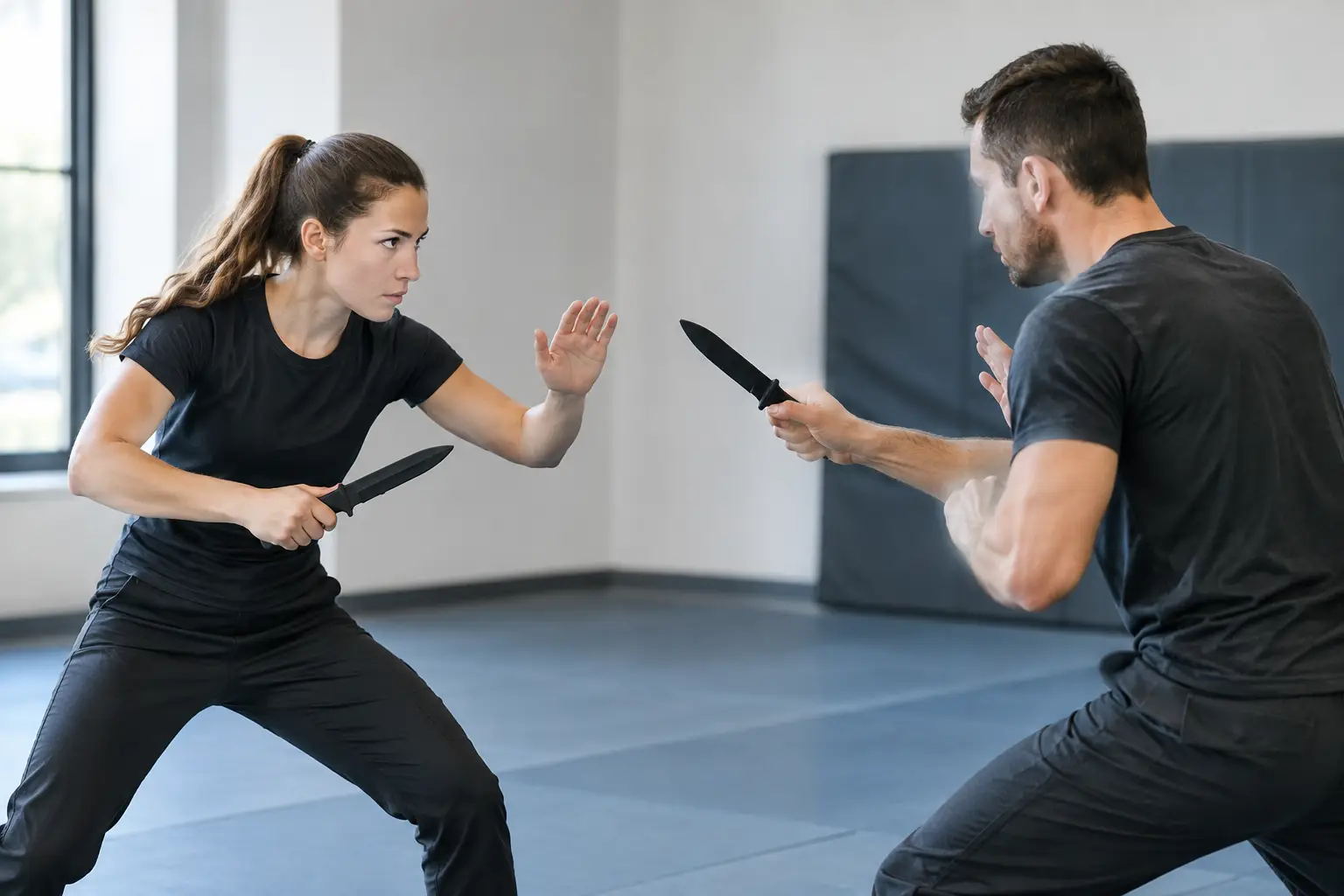
A training blade touches a partner faster than most students expect. That is why knife sparring safety rules are not a formality saved for the beginning of class. They are the discipline that allows realistic training to build skill instead of injuries, fear, or bad habits.
Knife training can develop awareness, timing, distance management, composure, and respect for the seriousness of edged-weapon encounters. But it must never become reckless play. The goal is not to prove who is tougher or faster. The goal is to make better decisions under pressure while protecting the people who train beside you.
Knife Sparring Safety Rules Start Before Contact
Safe sparring begins before anyone steps onto the floor. Every participant needs to understand the drill, the pace, the permitted actions, the boundaries, and the stop command. If any part of that is unclear, the round should not begin.
A controlled environment matters. Training space should be clear of bags, loose gear, water bottles, and spectators standing too close. Students should remove jewelry, secure long hair, and check that their protective equipment fits correctly. A small distraction can become a collision when movement speeds up.
The training tool must match the exercise. A soft training knife may work well for an introductory movement drill, while a firmer dedicated trainer may be appropriate for experienced students wearing the right protective gear. What should never be present in a sparring area is a live blade. There is no exception for someone who claims they are experienced, careful, or only watching.
Before each round, inspect the trainer. Look for cracks, sharp edges, damaged handles, or loose components. A worn tool can cause injury or alter the way a student moves. The same standard applies to protective equipment: if it cannot do its job, it does not belong in the drill.
Protective Gear Supports Control, Not Carelessness
Eye and face protection are especially valuable when drills involve speed, unpredictable movement, or rapid hand exchanges. Gloves and appropriate padding may also be needed depending on the intensity and equipment being used. The instructor should set the standard based on the drill, not on what a student feels like wearing that day.
Gear is not permission to hit harder. It reduces risk, but it does not erase risk. Students who feel invincible behind protective equipment often throw away the very control that makes training useful. Train with enough realism to learn, and enough discipline to return safely next class.
Set the Rules for Every Round
A good knife sparring round has a clear purpose. One drill may focus on maintaining distance. Another may test whether a student can recognize a threat, move safely, and create an opportunity to disengage. Trying to train every possible skill at full speed in one round usually produces chaos, not progress.
Partners should agree on intensity before contact. A beginner may need a slow, technical exchange where both people can see mistakes and correct them. More experienced students can work at a higher pace, but only if they have demonstrated control. Speed is earned through consistency, not demanded to impress someone.
Use a simple start, stop, and reset process. Begin only when both partners are ready. Stop immediately when either person calls for it, loses equipment, becomes disoriented, or moves outside the training area. Reset without argument. A student who keeps going after a stop command is not training realistically. They are creating a safety problem.
The instructor should also define what counts as a clean touch and what does not. That prevents students from escalating contact because they disagree about a point. In practical self-defense training, a touch is information. Treat it as feedback, acknowledge it, and learn from it rather than trying to “win” the exchange after the fact.
Respect the Tap and the Stop Command
A tap, verbal stop, or instructor command ends the action immediately. No delayed strike. No last-second grab. No debate while the drill is still active.
This habit has a larger purpose. Under pressure, students need to practice listening, processing, and making disciplined choices. Respecting a stop command shows that you can manage adrenaline rather than being managed by it. That control protects training partners and carries into every other area of martial arts practice.
Build Intensity in Stages
The fastest way to make knife sparring unsafe is to jump from basic movement straight into open, high-speed rounds. Students need layers of preparation. First, learn the movement pattern. Then add a partner. Then add timing, resistance, protective gear, and pressure in measured steps.
Cooperative drills are not fake training. They are where students build correct mechanics, posture, awareness, and communication. If someone cannot move safely at a controlled pace, adding resistance only makes the mistake happen faster.
As intensity rises, the rules may become more demanding. Space may be limited, reaction time may be shorter, and partners may be less predictable. But the core safety standard does not change: stay in control, recognize the stop command, and protect your partner.
Free sparring has a place, but it is not the starting point and it is not always the best answer. Sometimes a restricted drill teaches more. Limiting movement, objectives, or available responses can reveal a student’s habits without turning the session into an uncontrolled scramble.
Train for Awareness, Not Knife Fighting Fantasy
Real-world self-protection training should make students more cautious, not more confident about taking unnecessary risks. A knife encounter is dangerous, chaotic, and unpredictable. Even highly trained people can be injured. The best outcome is often to recognize danger early, create distance, escape when possible, and get help.
That perspective should shape knife sparring. Training is not about chasing flashy disarms or pretending that every threat has a clean solution. It is about developing calm awareness, sound judgment, and the ability to function when stress is high.
Scenario training can be useful when it is tightly supervised. The instructor should establish the context, control the pace, and make sure students understand when the scenario begins and ends. Students should not be surprised with a training weapon outside a planned drill. A realistic mindset does not require unsafe surprises.
At Urban Edge Martial Arts, realistic training means pressure with purpose. Students learn to respect weapons, understand their options, and build practical habits without losing sight of safety, responsibility, and control.
Choose Training Partners Who Help You Improve
A reliable partner does not try to overwhelm a newer student for ego. They match the assigned intensity, give honest feedback, and immediately reduce pressure when something feels unsafe. Good partners make each other sharper because both people can train consistently.
Speak up when a round feels too fast, too hard, or too confusing. That is not weakness. It is mature training. The same goes for parents watching youth programs: ask how drills are supervised, what equipment is used, and how instructors progress students from basic skills to higher-pressure work.
Beginners should expect a learning curve. Feeling awkward at first is normal. The answer is not to rush into hard sparring. Show up, practice the fundamentals, and let confidence come from competence.
Know When to Stop Training
Fatigue changes judgment. So do frustration, anger, and the urge to prove something. If you cannot control your movements, cannot focus on instructions, or find yourself reacting emotionally to every touch, step out and reset.
Report injuries right away, even minor ones. Clean the area, assess what happened, and do not return to the drill until it is appropriate. A disciplined school treats injury reporting as part of training, not as an inconvenience.
The most valuable knife sparring safety rule is simple: leave every partner better than you found them. Train hard enough to grow, stay controlled enough to protect your team, and return ready to improve again.