
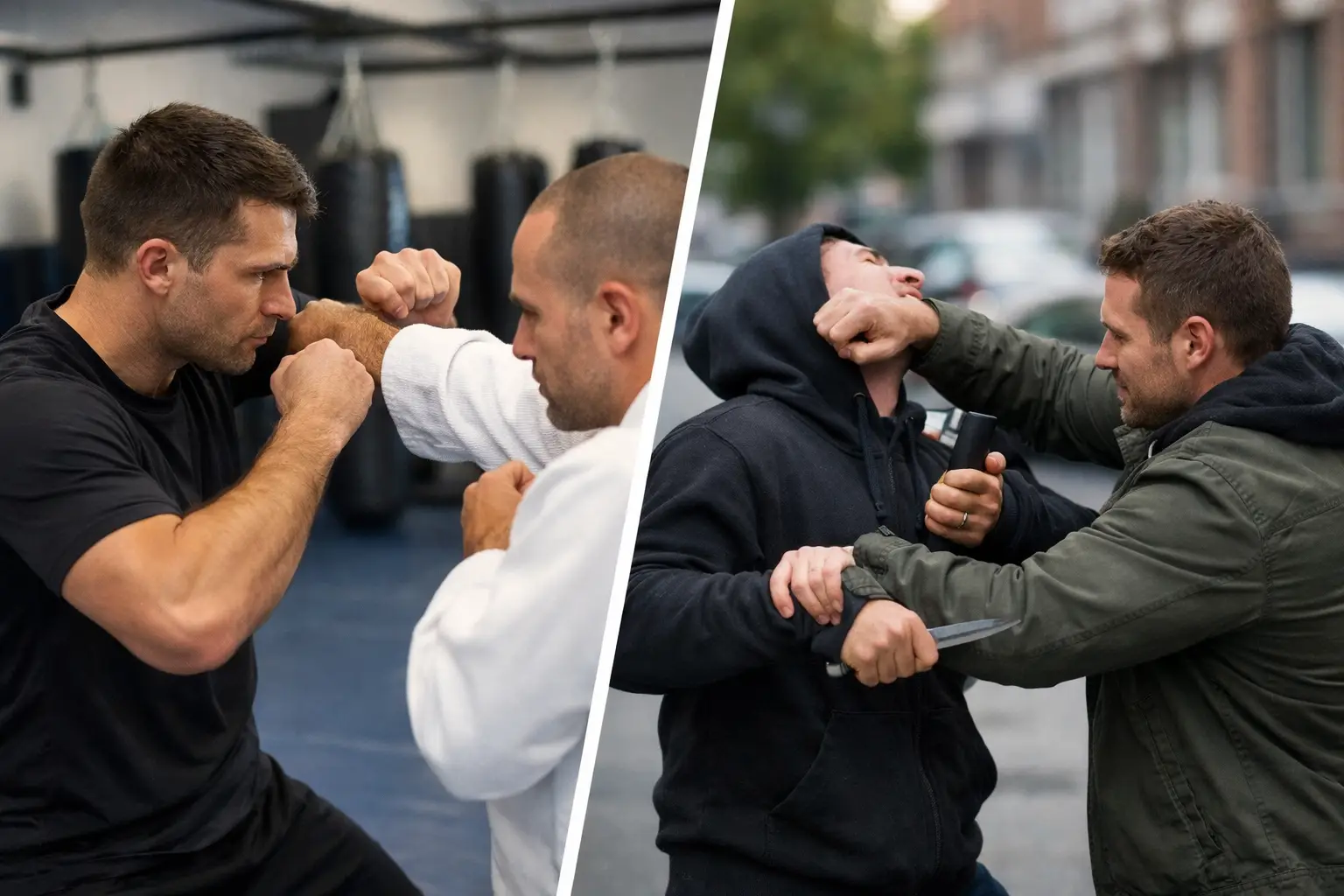
Most people do not worry about a perfect spinning kick in a parking lot, on a late walk home, or during a tense confrontation at close range. They worry about freezing, panicking, or not knowing what to do fast enough. That is why martial arts for real life situations has to be judged by one standard – does it help you handle pressure when the situation is messy, sudden, and unfair?
That question changes everything. It shifts the focus away from performance and toward survival, decision-making, and control. Real self-defense is not about looking impressive. It is about creating space, protecting yourself or your family, and getting out safely.
What martial arts for real life situations really means
A martial art can be traditional, modern, sport-based, or combat-focused. None of those labels automatically make it useful or useless. The real issue is how it is trained.
If your training assumes a cooperative partner, a clean stance, and plenty of time to react, it may fall apart under pressure. Real violence rarely gives warnings that are easy to read. It happens at awkward distances, in tight spaces, with adrenaline surging and your fine motor skills dropping fast.
Martial arts for real life situations should prepare you for that reality. That means training awareness, verbal boundaries, movement under pressure, close-range striking, escape skills, and the ability to make fast choices when the other person is not playing by any rules.
It also means accepting a hard truth. There is no perfect system. Every style has strengths, and every style has gaps. The goal is not to find magic techniques. The goal is to train in a way that builds useful habits.
The gap between sport and self-defense
Sport training can build timing, conditioning, toughness, and composure. Those are real advantages. A person who spars regularly often handles pressure better than someone who has never been hit, grabbed, rushed, or forced to react.
But self-defense is not the same as competition. In a match, there are rules, a referee, known boundaries, and usually one opponent. In a real encounter, there may be surprise, bad footing, hidden weapons, multiple attackers, or a confined environment like a hallway, elevator, or between parked cars.
That does not make sport training bad. It just means it is incomplete if your only goal is personal protection. A martial art becomes more useful for real life when training includes scenario work, verbal aggression, close-quarter response, weapon awareness, and the stress of imperfect conditions.
What to look for in practical training
If you want training that carries over outside the gym, pay attention to how classes are structured. Useful programs do not only teach techniques. They teach context.
A good instructor explains when something works, when it does not, and what the risk is. For example, a wrist grab escape may be worth learning, but if the bigger threat is the punch, tackle, or knife that follows, students need to understand that too. Practical training is honest. It does not pretend every move is high percentage in every scenario.
Pressure matters just as much as technique. You need reps against resistance, changing pace, and realistic reactions. That does not mean every class should feel reckless or chaotic. It means students should gradually build the ability to perform under stress instead of only memorizing patterns.
The best programs also cover prevention. Awareness, distance management, posture, and de-escalation are not soft skills. They are frontline self-protection tools. If you can spot trouble early, use your voice with confidence, and avoid getting pinned in a bad position, you have already improved your odds.
Why weapons training changes the conversation
Many people think of self-defense as empty-hand fighting. Real-world violence does not stay that simple. Knives, sticks, improvised impact tools, and other weapons change speed, distance, and consequences immediately.
That is why weapon awareness matters, even for beginners. You do not need fantasy-style drills or flashy disarms that only work on a compliant partner. You need to understand how quickly a weapon alters the threat, how to manage distance, how to protect vital targets, and when escape is the smartest option.
This is where a practical curriculum stands apart from a purely recreational one. Systems influenced by edged weapon training often develop sharper awareness of range, angles, and intent. That can improve empty-hand skills too, because students learn not to treat every confrontation like a clean exchange of punches.
At Urban Edge Martial Arts, that practical approach is part of the point. Training that blends weapons awareness with functional empty-hand skills gives students a more realistic view of what self-protection actually demands.
Confidence is a result, not a slogan
A lot of people start training because they want confidence. That makes sense. Maybe they have never been in a fight. Maybe they walk through the city feeling alert but unprepared. Maybe they want their child to carry themselves with more presence and composure.
Real confidence is not built by telling people they are dangerous. It comes from doing hard things in a structured environment and seeing progress over time. You learn how to hold your ground, how to move with intention, and how to recover when a drill does not go perfectly.
That kind of confidence looks different from ego. Ego makes people reckless. Confidence makes people calmer. In real life, calm is a major advantage.
Martial arts for real life situations should fit the person
A strong program should meet students where they are. A working professional with a full schedule does not need theory-heavy training that takes years before it becomes practical. A parent looking for a family activity wants real value, but also structure, safety, and a supportive culture. A teen may need confidence, discipline, and better decision-making as much as physical technique.
This is why one-size-fits-all answers usually miss the mark. The best martial art for a 10-year-old is not always the best one for a 40-year-old beginner. The best option for someone focused on fitness may differ from the best option for someone deeply concerned about urban safety. Still, the same core standard applies – training should develop awareness, functional movement, controlled aggression, and clear judgment.
For kids and teens, real-life training has to be age-appropriate. That means learning boundaries, verbal assertiveness, situational awareness, and basic physical responses without pushing them into material they are not ready for. For adults, it often means balancing practical self-defense with conditioning, stress relief, and sustainable progress.
The role of fitness and mental toughness
You do not need to be in great shape to start. You do need to understand that fitness supports self-defense. If you gas out quickly, move poorly, or cannot stay composed while tired, your options narrow fast.
Practical martial arts training improves more than striking or defense. It develops posture, balance, coordination, reaction time, and grit. These matter in real confrontations because your body has to obey your decisions under stress.
Mental toughness also gets misunderstood. It is not about acting fearless. It is about staying functional when your heart rate spikes and things stop feeling comfortable. Good training builds that gradually. Students learn to think while moving, breathe while under pressure, and keep going when the first answer fails.
How to tell if a school is serious about real-world readiness
Watch how they teach. Are students only rehearsing techniques in ideal conditions, or are they learning timing, resistance, and decision-making? Does the instructor talk honestly about avoidance, legal and ethical responsibility, and the unpredictability of violence? Is the environment intense in a productive way, or is it all theater and bravado?
A serious school does not need to advertise fantasy. It should be clear, structured, and grounded. Beginners should feel welcome, but standards should still be high. The goal is not to scare students. The goal is to prepare them.
That preparation often shows up in small details. How students manage distance. How they protect themselves while moving. How they handle pressure from different angles. How they respond when a plan breaks down. These are the habits that matter when life does not give you a clean setup.
Martial arts for real life situations is not about becoming invincible. It is about becoming more capable, more aware, and harder to overwhelm. That is a worthwhile goal for adults, teens, and families alike. Start with training that respects reality, commit to it consistently, and let your confidence come from competence.