
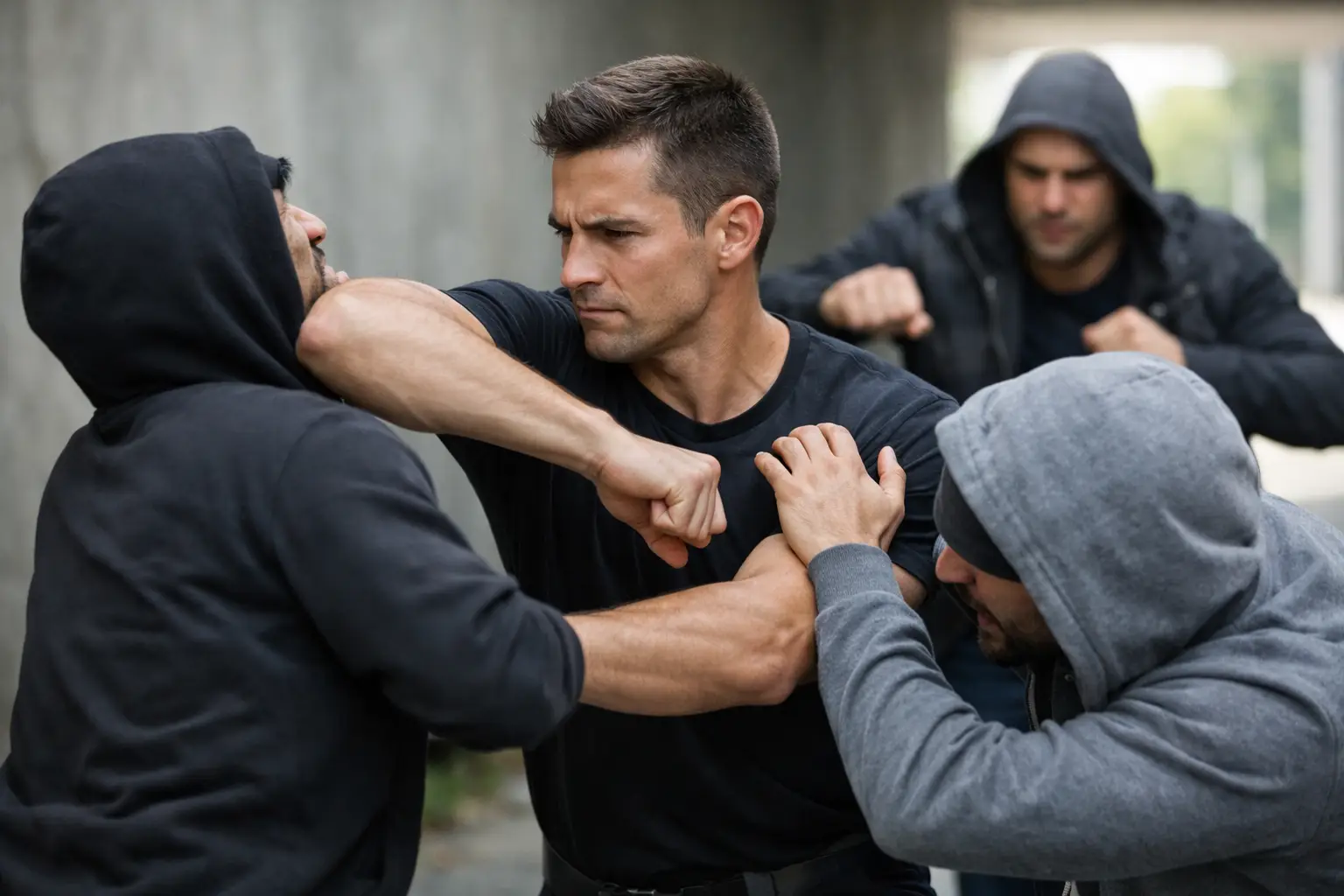
Two attackers change everything. The techniques that look sharp in a one-on-one drill can fall apart fast when a second person is cutting your angle, grabbing your arm, or closing distance while your attention is split. That is why self defense for multiple attackers has to be trained differently from standard sparring or point-based martial arts.
The goal is not to stand your ground and win a clean fight. The goal is to improve your odds, create a path out, and get home safe. That shift in mindset matters because it changes what you train, how you move, and what you stop pretending will work under pressure.
What self defense for multiple attackers really means
Most people picture a dramatic brawl with coordinated opponents. Real situations are usually uglier and less organized. One person distracts you while another circles. Someone grabs while another swings. A group crowds your personal space and forces bad reactions. It can happen in a parking lot, outside a bar, on transit, or anywhere movement is restricted.
In these moments, skill still matters, but priorities matter more. You are not trying to outfight a group. You are trying to manage chaos long enough to escape. That means protecting your head, staying on your feet, keeping attackers lined up instead of surrounded, and using fast, simple responses that hold up when adrenaline hits.
This is where many people get false confidence from traditional training. A technique can work well in a controlled class and still fail when there is noise, panic, uneven footing, and more than one threat. Pressure changes timing. Fear changes fine motor skill. Multiple attackers punish hesitation.
The first rule is movement, not trading shots
When more than one person is involved, staying in one place is a losing plan. If you plant your feet and exchange strikes, you give the second attacker a free angle. Movement is what buys you time.
Good movement in this context is not fancy footwork. It is practical positioning. You want to circle, cut angles, and keep one attacker between you and the others whenever possible. Think less about chasing damage and more about disrupting their ability to swarm. If they have to reset to reach you, you are buying seconds. Seconds matter.
Backing straight up is risky because obstacles, curbs, walls, tables, and parked cars can trap you. Side movement and angled exits are usually better. Your eyes should stay active. If your focus tunnels onto the first person in front of you, the second one becomes the real problem.
Why staying upright is critical
On the ground against one person, there may be options. Against several, the ground is usually where things get worse fast. Mobility disappears. Vision narrows. Kicks and stomps become a serious risk.
That does not mean ground skills are useless. They can help you scramble up, protect yourself during a fall, and avoid panic if you get knocked down. But in self defense for multiple attackers, the priority is to stay standing or get back up immediately. Clinching too long, chasing takedowns, or wrestling for position can expose you to the people you are not controlling.
This is one of those hard truths that serious training has to address. A tactic that dominates one attacker can be the wrong choice when others are within reach. Context decides what works.
Simple strikes beat complex combinations
Under stress, simple tools hold up better. Elbows, palms, low kicks, knees, and direct straight shots are generally more reliable than flashy combinations or high-risk spinning attacks. You need techniques that work in tight spaces, while moving, and without perfect setup.
Targets matter too. Eyes, nose, throat, groin, and knees are often discussed because they can create a quick reaction and open space. The point is not to trade until someone quits. The point is to stun, disrupt, and move.
That also means accepting that one clean hit may not stop anyone. Real attackers do not always react the way people do in demos. Some are bigger. Some are angry. Some are intoxicated. You may need to hit, frame, shove, and keep moving rather than waiting to see if your last shot worked.
Awareness prevents more fights than technique
The best outcome is avoiding the fight before it starts. That sounds obvious, but it is often ignored because it is less exciting than punching pads. Awareness is one of the most useful skills you can build.
Watch for crowding behavior, unnatural movement, people splitting to your sides, or one person engaging while another hangs back. Those are danger signs. If something feels off, create distance early. Cross the street. Change direction. Go into a store. Put a barrier between yourself and the group. Call for help. Get around other people.
Verbal skills matter here too. Clear commands like “Back up” or “Stay away” can help establish boundaries, attract attention, and support a legal claim that you were trying to disengage. Talking is not weakness. It is part of self-protection.
Environment can help you or trap you
Real self-defense happens in real places, not on open mats. Cars, walls, doorways, furniture, ice, bags, and poor lighting all change your options. A narrow hallway may prevent a group from surrounding you, while an open lot may force you to move more aggressively to avoid being flanked.
Barriers can be your friend. A parked car, bench, shopping cart, or doorway can slow attackers and break their line. Even a backpack or jacket can become a shield for a moment if someone is swinging or trying to close in. This is one reason scenario-based training matters so much. You need to practice making decisions with obstacles, not just memorizing techniques in perfect space.
Weapons change the equation immediately
Multiple attackers become more dangerous when even one person has a knife or impact weapon. At that point, the risk level spikes. Empty-hand skill still helps, but the margin for error gets much smaller.
This is where realistic training matters. People who have never dealt with weapon pressure often underestimate speed, range, and chaos. They also overestimate disarms. The smart approach is still the same at its core: move, create barriers, manage range, and escape. If contact is unavoidable, your response has to be direct and pressure-tested.
A practical curriculum that includes both empty-hand and weapon awareness gives students a more honest understanding of what these situations look like. It strips away movie logic and replaces it with workable habits.
How to train for multiple attackers without fooling yourself
Bad training creates false confidence. If every drill is cooperative, every attack is announced, and every defender gets to finish with a perfect technique, students leave with the wrong picture.
Useful training starts with fundamentals and then adds pressure in layers. First you learn movement, posture, striking, and awareness. Then you add verbal stress, surprise starts, confined spaces, uneven intensity, and decision-making. Sometimes the right answer is striking. Sometimes it is breaking contact immediately. Sometimes it is using one attacker as a shield while moving to an exit.
You also need training partners who understand control. Realistic does not mean reckless. The goal is to pressure-test skills safely enough that people can improve consistently. That balance matters for beginners, working adults, and teens alike.
At Urban Edge Martial Arts, this is why scenario-based training has value. Students are not just collecting techniques. They are learning how to function under pressure, move with purpose, and make better choices when a situation is messy and fast.
Fitness and mindset are part of the skill set
People often separate self-defense from conditioning, but in a real incident they are tied together. If you gas out in seconds, freeze under stress, or lose your footing because your balance is poor, technical knowledge will not carry you very far.
You do not need to be an elite athlete to improve your chances. You do need basic mobility, enough endurance to move hard for short bursts, and enough composure to think while scared. That is trainable. So is the mindset of not quitting when things get ugly.
Confidence also needs to be honest. The right kind of confidence does not tell you that you can beat a group. It tells you that you can spot trouble earlier, react faster, and do something useful under pressure. That is a much stronger foundation than fantasy.
Who should learn this kind of training
Working professionals, parents, teens, and adults who spend time in public spaces all benefit from practical self-defense. The risks are different for each person, but the need is the same. People want to feel less helpless, move with more confidence, and have a plan if something goes wrong.
For families, there is another benefit. Training builds awareness, discipline, and communication, not just physical skill. Teens learn how to carry themselves better and avoid bad situations. Adults get fitness and stress relief while building a real-world skill set. Everyone gains from structured practice that teaches judgment along with action.
If you want self defense for multiple attackers, look for training that is realistic, safe, and pressure-based. Look for instructors who talk honestly about escape, legal awareness, and the limits of technique. Look for a school that prepares you for chaos, not choreography.
You never get to choose the time, place, or conditions of a real encounter. You can choose how you prepare, and that choice has a way of changing how you carry yourself long before trouble starts.